Body & Bath
What's inside a bar of soap: reading the ingredient list
27 Sept 2026 • Neemyukt Research Team
The ingredient list on a soap wrapper is one of the most honest pieces of text in personal care, and one of the least readable. It is written in INCI, the International Nomenclature of Cosmetic Ingredients, a naming system that uses Latin botanical names and chemical names instead of the words printed on the front of the pack. So a bar made largely from coconut oil says sodium cocoate, and shoppers assume something synthetic has crept in when nothing has.
In short: Most soap bars are saponified fats, listed as "sodium" plus an oil name, so sodium cocoate is coconut oil and sodium tallowate is beef tallow, followed by water, glycerin, salt, a chelator, fragrance and colour. Ingredients are listed in descending order of weight down to roughly 1 percent, after which the sequence stops meaning much. The vaguest entries, "parfum" and unspecified plant extracts, are exactly where the label tells you the least.
What do names like sodium palmate and sodium cocoate mean?
They are the oils, after the oils have reacted. When a fat meets an alkali, the result is the salt of that fat's fatty acids, which is what soap physically is. That is why the oil no longer appears on the label under its own name: coconut oil becomes sodium cocoate, palm oil becomes sodium palmate, olive oil becomes sodium olivate. If you want the process itself rather than the vocabulary, the companion piece on how a soap bar is actually made covers it.
Plant or animal? The oil name tells you
Most of the "sodium" oil names are plant-derived: cocoate, palmate, palm kernelate, olivate, sunflowerseedate, castorate and shea butterate. The two to scan for are sodium tallowate, saponified beef or mutton fat, and sodium lardate, pork fat. Neither is spelled out in plainer language anywhere on the pack, so for anyone avoiding animal-derived ingredients on religious or personal grounds, those are the words that matter. Stearic acid and glycerin can also be plant or animal sourced without the label saying which.
Why the oil blend changes how the bar feels
Coconut-heavy bars lather fast and generously, and at high proportions can leave skin feeling tight, because the same fatty acids that foam well also lift more of your surface oils. None of that is visible on the front of a pack, but the order of those "sodium" names tells you which character to expect.
A quick decoder for common soap label entries
| What the label says | What it usually means |
|---|---|
| Sodium cocoate | Saponified coconut oil. Plant origin, fast bubbly lather. |
| Sodium palmate, sodium palm kernelate | Saponified palm or palm kernel oil. Plant origin, gives a firm bar. |
| Sodium tallowate, sodium lardate | Saponified animal fat (beef, mutton or pork). |
| Sodium olivate, sunflowerseedate, castorate | Saponified olive, sunflower or castor oil. |
| Aqua | Water. |
| Glycerin | A humectant that draws in water. Forms naturally during soap making, and is often added back. |
| Sodium chloride | Common salt, used to harden the bar and control texture. |
| Tetrasodium EDTA, tetrasodium etidronate | Chelators. They tie up metal ions from hard water, reduce soap scum and slow rancidity. |
| Sodium lauryl sulfate | A synthetic detergent with a strong foam, used in some bars and many wash products. |
| Sodium lauroyl isethionate, sodium cocoyl isethionate | Milder synthetic detergents typical of syndet bars. |
| Titanium dioxide, CI 77891 | A white pigment and opacifier that makes a bar look solid rather than translucent. |
| Parfum / fragrance | A fragrance blend. Individual materials are not disclosed, though named allergens may follow. |
How does ingredient order signal concentration?
Ingredients run in descending order of weight down to roughly 1 percent of the formula. Below that they may appear in any order, and colourants are often placed last regardless of quantity, so position matters at the top of a list and almost not at all near the bottom. Glycerin sitting in the first three or four entries points to a meaningfully glycerin-rich bar, while glycerin appearing after the fragrance is a trace. The difference in feel is real enough that it has its own comparison in glycerin soap versus regular soap.
One caution: order tells you proportion, not performance. A humectant present only in a trace amount, in a product you rinse off in under a minute, does less than the same ingredient in a lotion you leave on.
What does "contains no soap" mean on a syndet bar?
It means the bar cleans with synthetic detergents instead of saponified fat, so legally and chemically it is not soap. You can spot one because the "sodium something-ate" oil names are absent, replaced by surfactants such as sodium lauroyl isethionate, sodium cocoyl isethionate, disodium laureth sulfosuccinate or sodium methyl cocoyl taurate. True soap is alkaline by nature, while syndet bars can be formulated closer to skin's own mildly acidic surface pH, which is the main reason dermatologists often suggest them for dry or reactive skin. The background on that is in pH-balanced skincare explained.
Where sulphates fit in
Sodium lauryl sulfate is a capable cleanser and a common irritant in patch testing, which is why it shows up in sensitive-skin discussions far more than its cleaning ability alone would justify. Its milder cousins clean adequately with less stripping. The American Academy of Dermatology notes that gentle, non-stripping cleansing and shorter, cooler washes help skin hold onto moisture, which is their standard advice for dry skin. If your skin feels tight or itchy minutes after a bath, the wash step is worth examining first, as covered in our guide to SLS-free body wash.
What are the additives at the end of the list doing?
Chelators, salt and opacifiers
Tetrasodium EDTA and etidronic acid are there because Indian tap water is frequently hard: they bind calcium and magnesium, which keeps lather workable, limits the grey film on tiles and slows the oxidation that turns old bars musty. Salt hardens the bar, titanium dioxide makes it opaque. None of these do anything for your skin, and none are red flags.
Colour codes and the word parfum
CI numbers are Colour Index codes, an international register of pigments and dyes, so CI 77492 is an iron oxide and CI 42090 is a blue dye. "Parfum" is the vaguest entry on any wrapper, because one word can stand for dozens of individual materials. When you see names like linalool, limonene, citronellol or geraniol listed after it, that is disclosure of known fragrance allergens rather than a sign of a worse product. Fragrance-free remains the safer default for eczema-prone or very reactive skin.
What does a vague "natural extract" listing tell you?
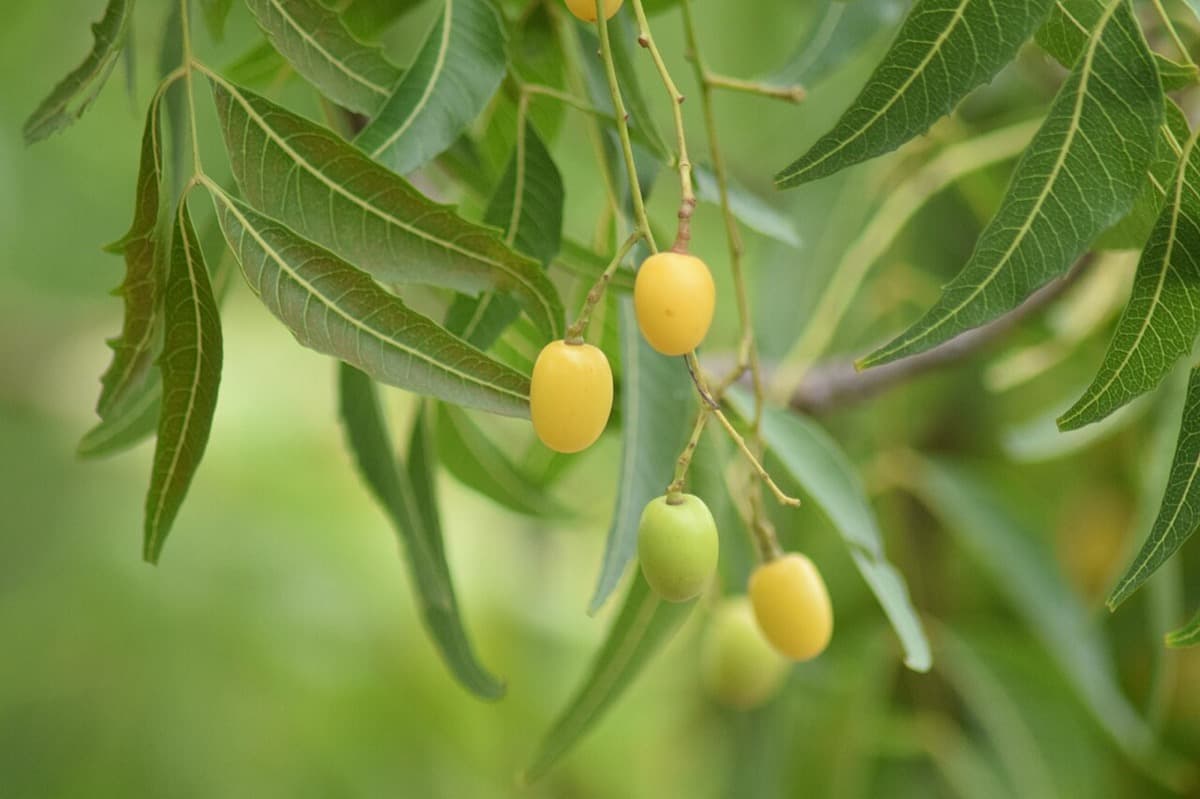
It tells you the botanical identity and nothing about strength. Azadirachta indica leaf extract confirms the species and the plant part, which is genuinely useful, but the label will rarely state whether the extract is a concentrated one or a heavily diluted infusion, and "extract" covers both. Position in the list is your only quantitative clue, and if the extract sits after the fragrance and the colourant, it is present in a small amount. The same logic applies across categories, which is why it is worth knowing how to read neem product labels before paying a premium for a front-of-pack claim.
A soap bar is a short-contact, rinse-off product, so the sensible expectation is daily cleansing that does not leave skin stripped, plus whatever comfort the oil blend and humectants provide. A glycerin-based bar such as a neem and tulsi glycerin bar or a neem and aloe vera bar is a supportive part of a routine, not a treatment.
Anything persistent belongs with a clinician. Recurring rashes, stubborn scalp or body flare-ups, acne that scars and anything painful need a dermatologist, who can prescribe an antifungal, benzoyl peroxide, adapalene or another proven option rather than leaving you to solve it with soap.
Frequently asked questions
Does a longer ingredient list mean a worse soap?
No. A simple three-oil soap can feel harsh, and a longer list can include a chelator, a humectant and a skin-conditioning agent that all make the bar more pleasant in hard water. Judge the identity and order of the ingredients rather than how many there are.
Can I tell from the label alone whether a bar will dry my skin?
Partly. A bar led by sodium cocoate or sodium palm kernelate with no humectant listed high up is more likely to feel tight, while syndet bars with isethionate surfactants and glycerin near the top usually feel milder. Your own skin, season and water hardness still decide the outcome, so a week of use tells you more than the wrapper.
What does a code like CI 77891 mean?
It is a Colour Index number, an international identifier for a specific pigment or dye. CI 77891 is titanium dioxide, the white pigment used to make bars opaque. Codes in the 77000s are inorganic mineral pigments; lower five-digit numbers are organic dyes, mostly synthetic.
Do clarifying bars suit oily or breakout-prone skin better?
Some people find a lighter, less oily-feeling bar such as a neem and tea tree clarifying bar more comfortable on the back and chest, where skin is thicker and sebum heavier. That is a comfort and preference judgement, not a medical fix, and if breakouts persist or scar, see a dermatologist. For a fuller routine, see the body care routine steps guide.