Body & Bath
How a soap bar is actually made
27 Sept 2026 • Neemyukt Research Team
Soap is one of the few things in your bathroom that is genuinely a chemical reaction rather than a recipe. Mix oil and lye and you do not get a blend of oil and lye. You get something molecularly new, with almost none of the original ingredients left intact. That single reaction explains most of what you feel when you switch bars, from how fast one melts away in the shower to whether your skin feels tight afterwards.
In short: Soap is made by reacting fats or oils with a strong alkali (sodium hydroxide for bars, potassium hydroxide for liquid soap) in a process called saponification. The reaction produces soap molecules plus glycerin as a natural by-product, The four main manufacturing routes are cold process, hot process, melt-and-pour and industrial milling. They differ mainly in how much heat is used, how long the bar cures, and whether that glycerin stays in the bar or is stripped out and sold separately.
What actually happens during saponification?
Fats and oils are triglycerides: three fatty acid chains attached to a glycerol backbone. A strong alkali snaps those fatty acids off the backbone and binds to them. Each freed fatty acid becomes a soap molecule, and the glycerol backbone is released: that is the glycerin. This is why no properly made soap contains lye in the finished bar. The alkali is consumed by the reaction.
Soap cleans because of the shape of that new molecule: one end is attracted to water, the other to oil, so in water the molecules surround a patch of grease and carry it away on rinsing. That mechanical lifting, rather than any chemical disinfection, is why the World Health Organization and public health bodies worldwide recommend handwashing with plain soap and water.
Different oils produce different fatty acids, and that is where a formulator has real control. Coconut oil gives a hard bar with big, quick bubbles but can feel stripping in high proportions. Olive oil gives a mild, low-lather bar that hardens over months, and castor oil boosts foam density. The finished bar is always a compromise between hardness, lather, longevity, and mildness, because no single oil does all four well.
What does "superfat" mean?
Superfatting is deliberately adding more oil than the alkali can react with. A small share of those oils stays unreacted and sits on the skin as emollient after rinsing, which is a large part of why one bar feels less tight than another. Bars aimed at dry or reactive skin usually carry a higher superfat; bars built to last long and lather hard carry less.
What are the four main ways soap gets made?
The chemistry is the same in every case. The engineering is not.
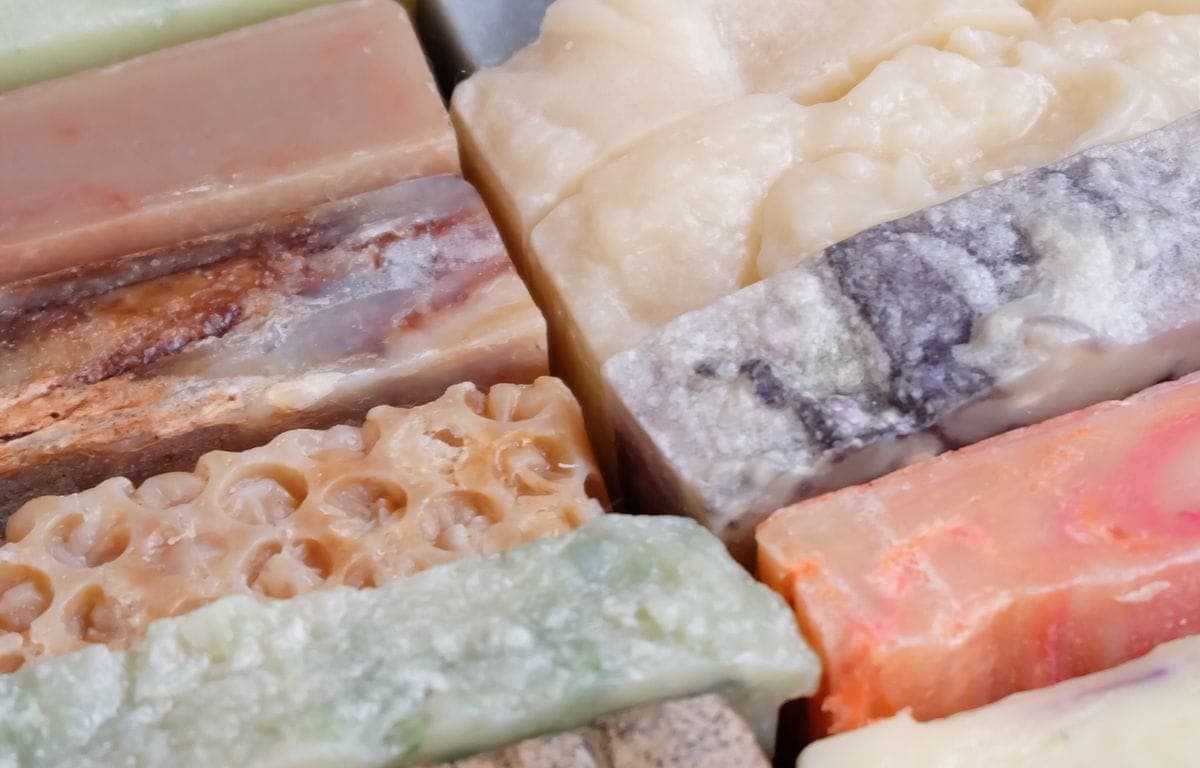
Cold process means the oils and alkali solution are combined at low temperature, blended to a thickened state, poured into moulds, and left alone. The reaction generates its own heat over the next day or two, then the bars are cut and cured for weeks. This route allows the widest control over oils, colour, and botanical additions, and keeps all the glycerin in the bar.
Hot process speeds things up by cooking the batter until saponification is essentially complete in the pot. The bar can be used much sooner, but the texture is rustic and less precise, and fragrance and delicate botanicals added before the cook can degrade in the heat.
Melt-and-pour starts with a pre-made soap base, often a transparent glycerin base, which is melted, scented, coloured, and re-set. Saponification already happened at a factory before the maker touched it, so there is no cure time and no lye handling, but also no control over the base formula.
Industrial milling and extrusion is how most supermarket bars are produced, in a continuous sequence:
- Fats are saponified continuously at scale.
- The soap is separated from the glycerin and brine.
- It is dried into pellets and mixed with additives.
- The pellets are milled between rollers.
- The mass is extruded into a long bar, then cut and stamped.
The result is consistent, hard and cheap. The same extrusion and stamping line also turns out syndet bars, which are built on synthetic surfactants rather than saponified fats and so are not technically soap at all. Our companion piece on reading the ingredient list on a soap wrapper walks through how to tell the two apart.
| Method | Heat used | Time to usable bar | Glycerin retained |
|---|---|---|---|
| Cold process | Low, self-generated | Several weeks of curing | Yes, fully |
| Hot process | Cooked in the pot | Days | Yes, fully |
| Melt-and-pour | Re-melted base | Hours | Depends on base |
| Milled / extruded | High, continuous | Immediate | Usually removed |
Why is glycerin removed from commercial soap?
Because it is worth more elsewhere. Glycerin is a humectant, meaning it draws water toward itself, and it is in demand for moisturisers, toothpaste, food, and pharmaceuticals. In continuous industrial production it is separated out and sold as a commodity, leaving a harder, longer-lasting, more shippable bar behind. It is an economic choice with a skin-feel consequence rather than a deception. We compare the two on skin in our post on glycerin soap versus regular soap.
What does curing actually do?
Curing is mostly water leaving. A freshly poured cold-process bar is chemically almost finished within a day or two, but it is still full of the water that carried the alkali. Over several weeks in open air that water evaporates, the bar hardens, it lasts noticeably longer in the shower, and the lather turns milder and creamier. A rushed bar dissolves fast and feels sharper. Curing conditions are also why handmade bars vary between batches in a way factory bars never do.
Does the manufacturing method change how a bar behaves on skin?
Yes, though less dramatically than marketing suggests. Three variables genuinely matter: the oil blend, the superfat level, and whether glycerin is present. A glycerin-retaining, generously superfatted bar from a mild oil blend usually feels more comfortable on dry or reactive skin than a heavily coconut-based, glycerin-stripped commodity bar. That is a formulation difference, not magic conferred by being handmade.
There are limits worth stating. All true soap is alkaline, sitting above skin's own slightly acidic surface pH, and while healthy skin recovers after washing, frequent washing, very hot water and long contact time make that recovery harder. If you have eczema, rosacea or persistently compromised skin, the American Academy of Dermatology's guidance on dry skin points to gentle, fragrance-free cleansers and short lukewarm showers, and a low-pH syndet cleanser or an SLS-free body wash may suit you better than any bar. Our explainer on what pH-balanced actually means unpacks that.
Within the bar category, botanical additions shift the character rather than the chemistry. A neem and tulsi glycerin bar is built as a purifying daily cleanse, while a neem and aloe vera bar leans more moisturising for skin that tightens in dry months. Both are supportive cleansing steps, not treatments.
Anything stubborn belongs with a clinician. Persistent acne, scaling or a rash that will not settle needs a professional assessment, and may call for a prescription option such as benzoyl peroxide, adapalene or an antifungal, none of which a soap replaces.
Frequently asked questions
Is there lye left in handmade soap?
No, not in a correctly formulated bar. The sodium hydroxide is consumed during saponification, which is why it appears on ingredient lists even though it is not present in the finished product. Superfatting leaves a small excess of oil so no free alkali can remain. A bar that stings or feels caustic was made wrong.
Why does my handmade soap disappear so quickly?
Usually glycerin content, a short cure, and storage together. Glycerin attracts water, so a glycerin-rich bar softens in a wet, closed dish. Keep it on a draining dish with air around it and let it dry between uses.
Are transparent bars better than opaque ones?
Transparency is a formulation effect, not a quality marker. Clear bars generally contain solvents such as added glycerin, alcohol, or sugar syrup that stop soap crystals forming an opaque structure. Judge the oil blend and additives instead of the look.
Is handmade soap automatically gentler than factory soap?
No. Gentleness comes from the formula, not the scale of production. A handmade bar that is almost entirely coconut oil with minimal superfat can be harsher than a well-designed industrial syndet bar. If your skin is sensitive, our sensitive skin ingredients guide is a more useful filter than the handmade label, and a dermatologist's input is worth having if irritation keeps returning.
So "how it's made" matters mainly because of what it settles about the formula. Learn to read those signals and the wrapper becomes the next thing worth decoding.